Publié le
- Sécurité et sûreté
Electronic hotel locks: enhancing the guest experience while guaranteeing security
Partager
The market for electronic hotel locks is experiencing exceptional growth. This remarkable development testifies to the growing importance of these systems in the modern hotel industry.
Indeed, we’re seeing that electronic locks are radically transforming the customer experience, while at the same time enhancing the security of establishments. What’s more, these innovative systems, whether card readers or connected locks, offer exceptional versatility. In particular, their integration with hotel management software enables the automation of check-in and check-out processes, as well as centralized access control.
In this article, we’ll explore the different facets of electronic hotel locks, their impact on the customer experience, and the many solutions available to optimize your establishment’s security.
The evolution of hotel locks: from traditional keys to RFID technology
The hotel industry has undergone a profound transformation in its room access systems. The quest to improve the guest experience while enhancing security has pushed the sector to evolve rapidly, from rudimentary solutions to cutting-edge technologies.
The limits of traditional hotel locks
In the past, most hotel locks consisted of a relatively simple mechanical system using physical keys. These devices had the advantage of simplicity: no need for electricity or complicated technology! What’s more, their initial cost was generally lower than that of modern solutions, a significant advantage for establishments looking to minimize their expenses.
However, these traditional locks had a number of drawbacks. When a key was lost, the entire cylinder often had to be replaced to maintain security, incurring additional costs. In addition, keys could easily be duplicated, representing a potential security risk. And then there’s the practical side: they take up too much space in pockets, and there’s a high risk of loss.
The emergence of magnetic cards: the first revolution
The first major revolution in this field came with the advent of magnetic cards. In 1975, Tor Sørnes patented the first electronic card lock, opening up a new market for programmable locks. These cards, equipped with a magnetic strip, contain unique identification information that customers use by swiping the card through a reader attached to the door.
This innovative system has enabled hotels to more easily manage access to rooms based on reservations and departures. If a card is lost, all that’s needed is to create a new one with a different code, without having to physically change the lock. Nevertheless, these cards still have a few weaknesses: they can become demagnetized, particularly when they come into contact with other cards or electronic devices, and require precise scanning to operate correctly.
RFID technology: towards a contactless experience
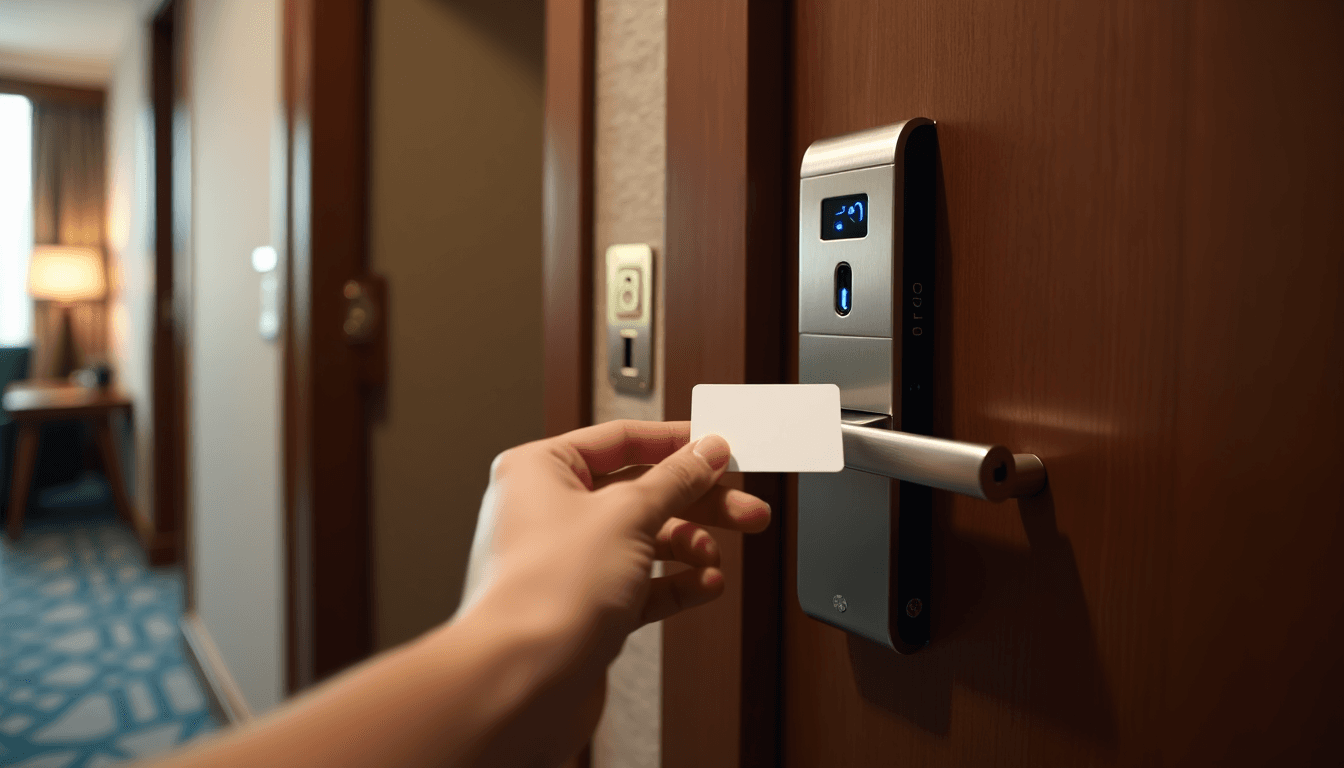
RFID technology marks a new era in the evolution of electronic hotel locks. Unlike magnetic stripe systems, which require the card to be inserted into the reader, RFID technology enables radio wave communication between the card and the receiver, without physical contact.
RFID cards offer a higher level of security thanks to advanced encryption, making them much harder to duplicate. Tap-and-go access speeds up entry, reducing waiting times and customer frustration. What’s more, as they are contactless, they are more hygienic and less prone to wear, prolonging their life.
Although the initial investment is higher, including the cost of RFID readers and compatible locking systems, long-term costs are reduced thanks to the durability of the cards and the reduced need for frequent replacement.
The different types of smart hotel locks
Hotel establishments today have a range of locking technologies at their disposal, each offering specific benefits tailored to different operational and budgetary needs.
Magnetic badge locks: the proven standard
Magnetic card locks are a popular choice due to their ease of use. This system, in which the guest swipes his or her card through a slot, offers a well- established, cost-effective solution. Particularly widespread in the hotel industry since the 1970s, these locks have represented a veritable silent revolution. However, they have certain limitations: rapid wear of magnetic strips and vulnerability to demagnetization on contact with electronic devices.
RFID locks: the versatile solution
RFID technology marks a significant improvement over magnetic cards. Customers no longer need to swipe their cards, but simply hold them up to the reader. This contactless system offers encrypted security, preventing unauthorized duplication and reducing hardware wear and tear. What’s more, its flexibility enables integration with other systems such as cash registers.
RFID locks: high-performance models for optimum security
RFID locks are available in a range of models tailored to the specific needs of hotels, whether budget, upscale or undergoing renovation. Thanks to their contactless technology, they ensure smooth, secure access for guests and staff alike. Here are three key models to consider:
G456M VALUE: the economical and reliable option

Designed for hotels under construction or renovation, the G456M VALUE combines simplicity and efficiency. Its stand-alone operation with RFID technology (13.56 MHz) guarantees smooth access management. CE and UL certified, it offers high security thanks to its stainless steel mortise lock and panic function for rapid opening in emergencies.
G256M ELEGANT: design for safety

With its refined, modern design, the G256M ELEGANT will appeal to establishments looking for an attractive lock without compromising on security.
Suitable for hotels under construction or renovation, it features robust materials and a high-resistance stainless steel handle. Fire-resistant and compatible with BISHÔTEL software, it combines elegance and performance.
G1A8M GUARDIAN: the top-of-the-range lock

Ideal for luxury hotels, the G1A8M GUARDIAN stands out for its sturdiness and meticulous design. Waterproof and fire-resistant, it is approved for fire doors and features a 3-point stainless steel latch with anti-friction mechanism. Its ergonomic design and durable finish make it a premium choice for an optimal customer experience.
Thanks to these models, hotels can choose a solution tailored to their positioning and safety requirements.
Optimizing hotel room security with advanced technologies
Security is a major concern for hotel establishments in a world where threats are constantly evolving. Today’s electronic hotel locks offer advanced features that go far beyond simple access control.
Access traceability and activity logs
Modern electronic lock systems systematically record usage history, providing precise traceability of entries and exits. This internal memory can store data,
creating a detailed access log. In fact, every badge used leaves a digital imprint in the system, enabling managers to know exactly who entered which area, at what time.
This feature becomes particularly valuable when incidents occur. Thanks to this activity log, it is possible to examine past events at a specific date and time, offering tangible, irrefutable proof in the event of litigation or infringement.
Intrusion prevention
In the face of intrusion risks, electronic hotel locks offer advanced encryption technologies that make unauthorized duplication virtually impossible. Unlike mechanical locks, which are easy to pick, these systems offer optimum protection.
What’s more, integration with other security devices enhances this protection. Some solutions can be connected to alarm or video surveillance systems, creating a coherent security ecosystem. In the event of an attempted break-in, an alert can be automatically triggered, enabling rapid intervention.
Finally, back-up protocols are in place in the event of a power failure, with emergency solutions such as mechanical emergency opening, guaranteeing uninterrupted access even in exceptional situations.
Conclusion
Electronic locks are now an essential element of any modern hotel. More than just an evolution of traditional access systems, this technology radically transforms the guest experience, while enhancing security.
Investment in these intelligent systems is particularly relevant in the face of rising traveler expectations. Establishments adopting these security technologies demonstrate their commitment to innovation and customer satisfaction, two key success factors in the modern hotel industry.